
blog
GIFs in Email: Test the Frame Your Customers May See
Make animated email GIFs useful when motion stops. Review the first frame, a real-text CTA, loading and client playback before approving a campaign.
A product spins, the new color appears, and the discount arrives on the last frame. It is a neat little story until a customer sees only the opening image. If that frame is blank or says "Wait for it," the useful part of the campaign has disappeared.
Before using a GIF in an email, make its first frame understandable and keep the offer and primary action in real text. Then check two things separately: how the email looks as a still, and whether the animation actually plays in the clients you care about.
Start with the frame that can stand alone
A good first frame gives the customer something useful immediately. It might show the featured product, the event name or the result of a short demonstration. Motion can add detail afterwards.
Consider this illustrative sale concept. These are design choices to review, not measured client results:
| Part of the campaign | Fragile version | More useful alternative |
|---|---|---|
| First frame | Empty box; "Something is coming" | Product and collection name |
| Later frames | Offer appears only at the end | Offer stays visible |
| Copy below the GIF | "Did you catch that?" | Offer and deadline in text |
| Primary action | Button drawn inside the GIF | Real-text button below it |
Ask the designer to export the first frame as a still alongside the GIF. Put that still in a duplicate campaign and read the complete email without playback. If the message now needs an explanation, revise the artwork or surrounding copy.
This static control is valuable even when animation works. Some readers skim quickly, stop scrolling before the reveal, or simply do not wait for another loop.
Do not treat every Outlook as the same app
Animation behavior depends on the client and version. Litmus' Outlook rendering reference describes version-dependent GIF playback and first-frame fallbacks. That is a reason to test named targets, rather than label every Outlook result "animated" or "static."
Identify whether the audience uses Classic Outlook for Windows, New Outlook, Outlook web or a mobile app. The Outlook version guide helps separate them.
If your designer provides an Outlook-specific still image, review that actual fallback too. The intended first frame and the image supplied through a conditional template may be different files. Both need the correct product, offer and destination.
Use screenshots for appearance and a live message for motion
A PNG capture shows a single moment. It can reveal a missing image, awkward dimensions, unreadable text in the captured frame or broken surrounding layout. It cannot establish that a GIF played, looped correctly or completed its sequence.
Use this division of checks:
- MailSlurp device previews: inspect the delivered layout, visible image state, surrounding copy, button and client differences.
- A received message opened in the named app: watch the sequence, its timing and any playback controls.
- A first-frame control: confirm that the static experience still communicates the offer.
If playback is a campaign requirement, record what you observed in the live message, including the app and version. Do not mark animation as passed from a still screenshot or from the GIF playing in the design tool.
Send the GIF through your actual email platform
Upload the approved GIF through the campaign builder's image workflow, then send a test of the complete campaign. Check the received message so you know the platform kept the intended asset.
For a Mailchimp campaign, start a MailSlurp device preview, select the relevant clients and copy its render address. Send the campaign test to that address, then open the finished results. The Mailchimp rendering walkthrough covers the exact handoff.
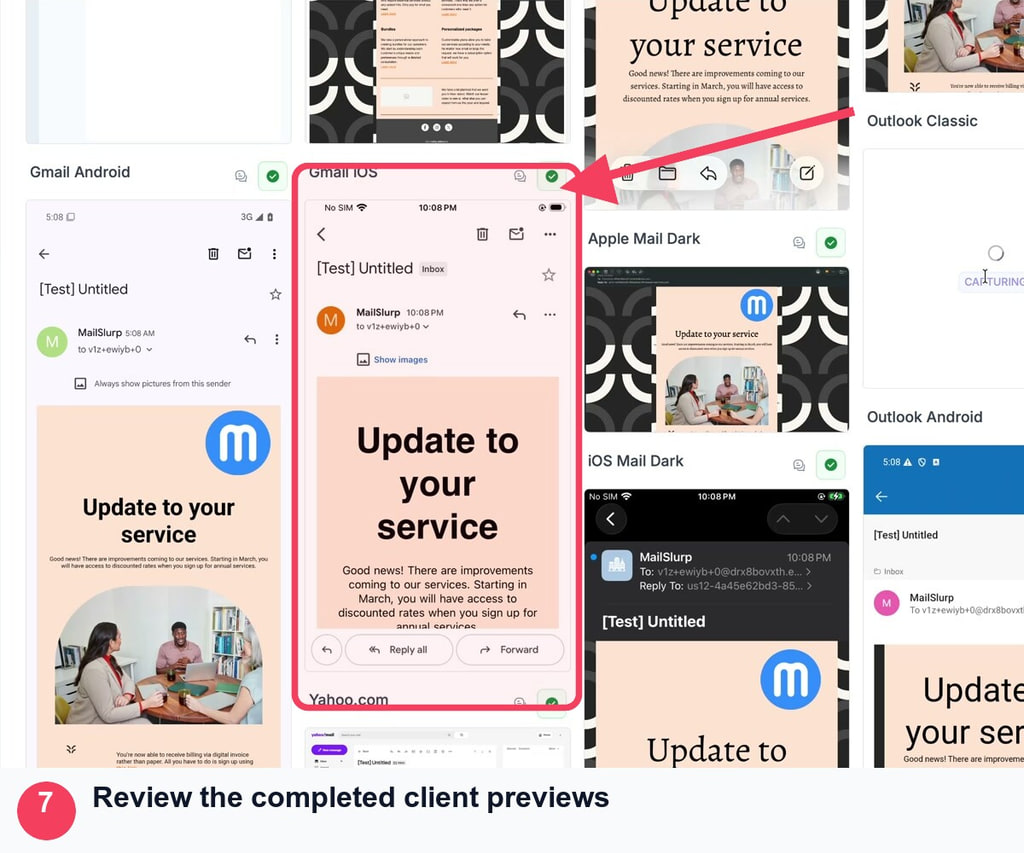
Use a controlled test inbox for the separate live playback check. Open the delivered email there rather than opening the image URL alone. That keeps the animation inside the environment where the customer will encounter it.
Reduce waiting without making the message cryptic
A long sequence with many large frames can be expensive to download. Start by removing frames that do not explain anything, shortening repetitive loops and exporting at dimensions appropriate to the email. Compare the result visually after each reduction.
Keep text in the artwork legible. Aggressive compression or a smaller export can make a discount code difficult to read even when the file loads faster. If the information matters, repeat it in real email text.
Review the transition back to the first frame. A loop that flashes between very different surfaces can distract from the action below it. If the movement adds little, a well-chosen still may communicate the same idea more comfortably.
Use your team's accessibility requirements for motion and flashing. Avoid making the reader follow a fast sequence to obtain essential instructions or understand a condition.
Check the message when the GIF is unavailable
A first-frame fallback still depends on an image loading. If the image is blocked or its URL breaks, even a thoughtful opening frame can disappear.
Read the headline, offer and call to action without the artwork. The missing-image guide shows a real example where the text and link survive an unavailable image. Give meaningful artwork useful alternative text, while keeping essential conditions in the visible body.
Open the primary link from a received test message and confirm the intended destination. An attractive animation should not distract the reviewer from a wrong product link or expired landing page.
Keep animation and inbox placement as separate checks
Converting a video to a GIF does not guarantee that a campaign avoids spam. Appearance and mailbox placement answer different questions. Use inbox placement testing when you need to check where a campaign lands, and device previews when you need to inspect what recipients see.
For the final GIF approval, confirm the still is useful, the text carries the offer, the image fits, the required live playback works, and the action leads to the right place. Then send the exact approved revision. The animation can reward attention without making attention a prerequisite for understanding the email.