
blog
Email Verification Code API for OTP Extraction from Inbound Email
Extract one-time verification codes from inbound email with deterministic parsing designed for CI tests, auth workflows, and automation reliability.
Email verification looks simple from a user perspective: submit an email, receive a code, enter the code, continue.
From an engineering perspective, it is one of the most common sources of flaky automation.
Templates evolve, multiple numbers can appear in the same message, and parser logic scattered across test suites becomes difficult to trust over time.
This is exactly where MailSlurp helps. MailSlurp gives you programmable inboxes plus API endpoints for message retrieval and parsing.
For verification code extraction from inbound email, use:
POST /emails/{emailId}/codes
This endpoint gives you a structured and repeatable extraction result you can use in CI, integration tests, and message-driven automation flows.
What MailSlurp Is in This Workflow
At a high level, MailSlurp is the inbox layer of your test or automation stack:
- create inboxes
- receive inbound messages
- fetch message content
- extract values (like OTP codes)
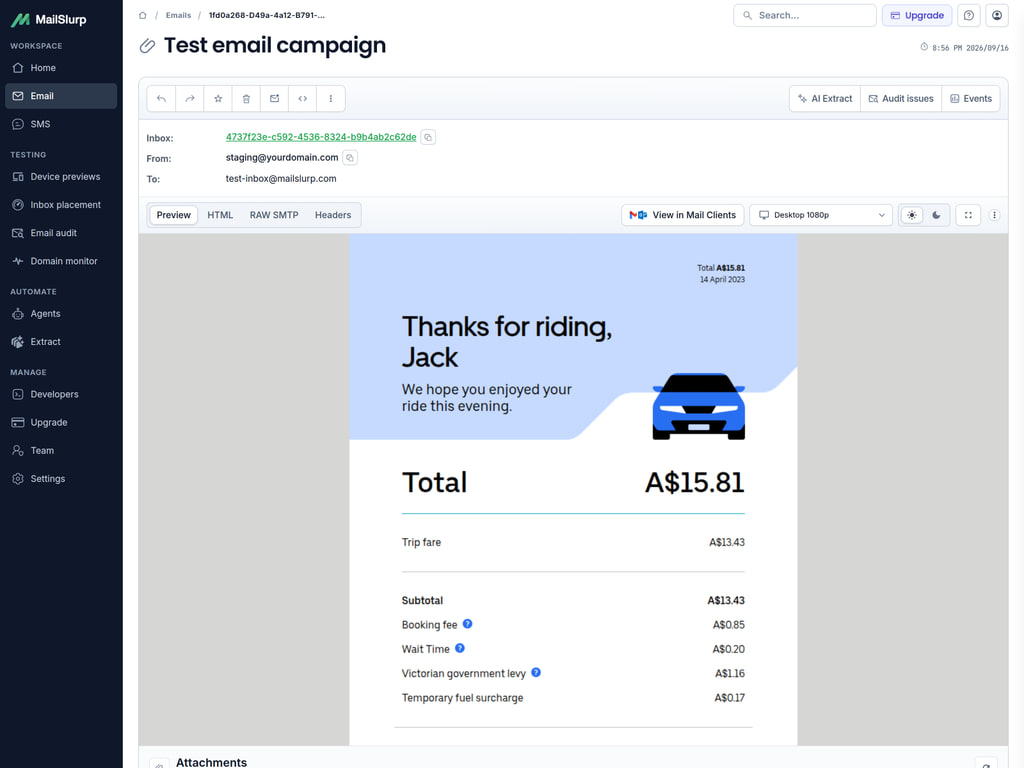
Instead of writing and maintaining parser code in every test project, you can centralize code extraction with the MailSlurp API.
API Base URL and Authentication
MailSlurp API base URL:
https://api.mailslurp.com
Authentication header:
x-api-key: YOUR_API_KEY
Suggested shell setup:
export API_KEY="your-mailslurp-api-key"
Where This Endpoint Fits in a Real Flow
A typical auth automation flow:
- Trigger signup, login challenge, or password reset in your app.
- Wait for inbound email in a MailSlurp inbox.
- Get the
emailIdfor that message. - Call
/emails/{emailId}/codes. - Submit the returned code to your verify step.
This pattern is useful in:
- end-to-end test pipelines
- smoke tests for critical auth paths
- staging environment validation
- internal QA tooling
Endpoint
POST /emails/{emailId}/codes
Request Body
{
  "method": "AUTO",
  "allowFallback": true,
  "minLength": 6,
  "maxLength": 6,
  "maxCandidates": 5,
  "customPatterns": ["verification code[: ]+(\\d{6})"]
}
Parameter Guidance
method: extraction strategy.AUTOis a strong default for most teams.allowFallback: whentrue, unavailable method paths can degrade gracefully.minLengthandmaxLength: the most effective way to reduce false positives.maxCandidates: keeps output manageable for deterministic assertions.customPatterns: useful when your template phrasing is stable and known.
cURL Example
curl -sS -X POST "https://api.mailslurp.com/emails/$EMAIL_ID/codes" \
  -H "x-api-key: $API_KEY" \
  -H "content-type: application/json" \
  -d '{
    "method": "AUTO",
    "allowFallback": true,
    "minLength": 6,
    "maxLength": 6
  }'
JavaScript Example
const response = await fetch(`https://api.mailslurp.com/emails/${emailId}/codes`, {
  method: "POST",
  headers: {
    "x-api-key": process.env.MAILSLURP_API_KEY,
    "content-type": "application/json",
  },
  body: JSON.stringify({
    method: "AUTO",
    allowFallback: true,
    minLength: 6,
    maxLength: 6,
  }),
});

const result = await response.json();

if (!result.found) {
  throw new Error(`No verification code found. Warnings: ${(result.warnings || []).join("; ")}`);
}

console.log("verification code:", result.code);
Example Response
{
  "found": true,
  "code": "734921",
  "methodUsed": "PATTERN",
  "candidates": [
    {
      "code": "734921",
      "confidence": 0.95,
      "method": "PATTERN",
      "source": "RAW_TEXT_PART",
      "context": "Your verification code is 734921."
    }
  ],
  "warnings": []
}
Why the Structured Response Matters
The single most useful improvement over hand-written parser logic is observability.
You get:
foundfor clean assertionscodefor immediate use- ranked
candidatesfor debugging ambiguous messages warningsfor visibility into fallback or extraction quality
That makes failures easier to diagnose and reduces time spent reproducing parser bugs.
Reliability Patterns for CI
Use two extraction profiles in your test suite:
- Resilient mode with
allowFallback=truefor broad regression stability. - Strict mode with
allowFallback=falsefor targeted parser contract checks.
This prevents brittle failures from blocking all pipelines while still surfacing real extraction regressions.
Common Failure Cases and Mitigations
- Wrong numeric token selected: set exact length constraints and add a template-specific pattern.
- Template wording changed:
update
customPatternsand monitorwarningsfor drift signals. - Intermittent failures in CI:
persist
methodUsed,source, and warnings in test artifacts.
Business Value for Teams
Teams that centralize verification-code extraction with MailSlurp usually get:
- less duplicated parser code across repos
- fewer flaky auth tests
- faster diagnosis when message templates change
- cleaner QA ownership boundaries
If your product relies on email verification, this endpoint is one of the highest-leverage API calls you can add to your automation stack.