
blog
Cypress Email Testing and Email Verification for OTP, Password Reset, and Signup Flows
Learn how to do Cypress email testing and Cypress email verification with real inboxes so you can verify account confirmation, password resets, OTP codes, and transactional messages without brittle polling hacks.
If you searched for cypress email testing, you probably want to finish a real user flow, not stop at the moment your app says "email sent."
This guide explains how to do Cypress email testing with isolated inboxes, safer waits, and assertions against links, codes, and message content. It also shows where Cypress is strong, where teams make tests flaky, and when to route into a more general email integration testing workflow.
Quick answer
Cypress email testing should let you control the message layer inside the same test run:
- generate a private disposable inbox for each test or run
- trigger an application flow that sends a real email
- wait for the matching message with bounded timeouts
- assert subject, sender, links, codes, and content
- continue the browser test using the extracted artifact
If your workflow still relies on a shared mailbox or a local SMTP viewer that does not behave like production, you are not testing the full path.
Use the email testing API for programmable inbox and wait controls, Email Sandbox for safe staging capture, and the official Cypress plugin example for the complete cypress-mailslurp setup. Use Authentication testing when email and SMS are part of login or recovery, and Phone number and SMS service when Cypress needs to complete SMS verification too.
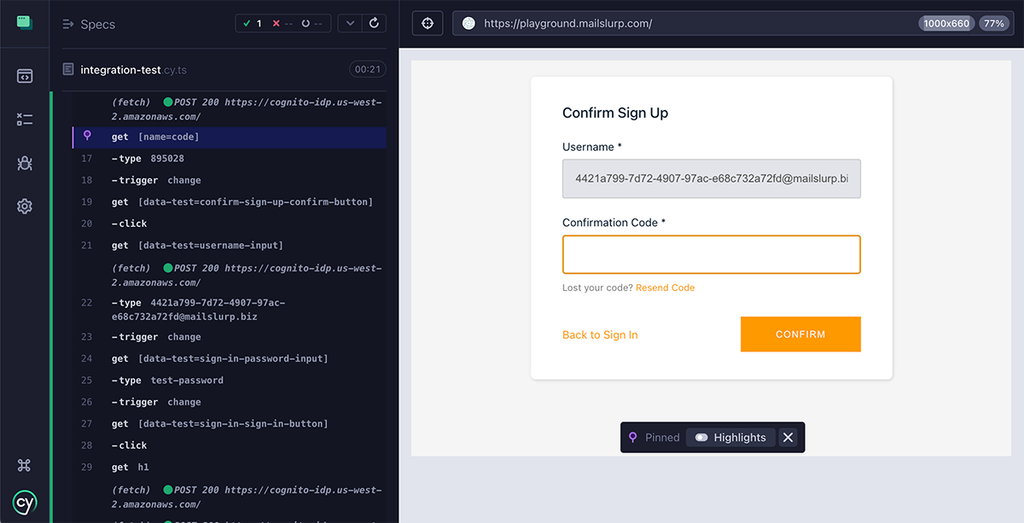
Common Cypress email testing scenarios
Teams usually use Cypress email testing for:
- account verification
- password reset
- invite acceptance
- newsletter signup
- approval workflows
- transactional notifications
- email OTP or magic-link flows
The intent is always the same: finish the browser path and prove the message layer did the right thing.
For Cypress email verification, the useful assertion is not only that an email arrived. The test should prove the message belongs to the current run, contains the expected link or code, and lets the browser reach the verified state.
What basic Cypress email guides usually cover and miss
Basic setup guides often cover the loop:
- send an email
- poll an inbox
- assert content
That is useful, but it usually misses:
- parallel test safety
- message selection in noisy inboxes
- retry and timeout discipline
- assertions for expiring links or codes
- a clean path from email testing into SMS or MFA coverage
That is where most Cypress suites start failing in CI.
A better Cypress email testing pattern
Use a fresh inbox per scenario or per test run.
Then:
- trigger the flow in the app
- wait for the expected message
- assert the message belongs to the current run
- extract the artifact you need
- continue the Cypress test
This reduces test pollution and makes failure analysis much easier.
How do I read email in Cypress?
Install the official cypress-mailslurp plugin, import it in Cypress support, and call cy.mailslurp() to access the standard MailSlurp client. Create one inbox for the test, wait for a message whose subject matches the current journey, extract its verification link or OTP, and delete the inbox in afterEach.
Import the plugin once in cypress/support/e2e.ts:
import "cypress-mailslurp";
Then keep inbox creation, matching, browser continuation, and cleanup in one test lifecycle:
/// <reference types="cypress-mailslurp" />

describe("signup email verification", () => {
  let inboxId: string | undefined;

  afterEach(() => {
    if (!inboxId) return;

    cy.mailslurp().then((mailslurp) =>
      mailslurp.inboxController.deleteInbox(inboxId!),
    );
  });

  it("creates a user and verifies the confirmation email", () => {
    cy.mailslurp()
      .then((mailslurp) => mailslurp.createInbox())
      .then((inbox) => {
        inboxId = inbox.id;

        cy.visit("/signup");
        cy.get('input[name="email"]').type(inbox.emailAddress);
        cy.contains("button", "Create account").click();

        return cy
          .mailslurp()
          .then((mailslurp) =>
            mailslurp.waitController.waitForMatchingFirstEmail({
              inboxId: inbox.id,
              timeout: 60_000,
              unreadOnly: true,
              matchOptions: {
                matches: [
                  { field: "SUBJECT", should: "CONTAIN", value: "Verify" },
                ],
              },
            }),
          )
          .then((email) => {
            const verificationUrl = email.body?.match(
              /https:\/\/[^\s"]+verify[^\s"]+/,
            )?.[0];
            expect(verificationUrl).to.be.a("string");

            cy.visit(verificationUrl!);
            cy.contains("Account verified").should("be.visible");
          });
      });
  });
});
The subject rule prevents an unrelated message from satisfying the assertion, the 60-second timeout keeps the wait bounded, and afterEach cleans up even when the browser assertion fails. For parallel CI, keep inboxId inside the spec or test scope and create a separate inbox for every worker—never share a Gmail inbox or a suite-wide alias across parallel jobs.
The same structure works for Cypress password reset tests. Create the inbox, request the reset email, extract the reset link, set the new password, and assert the user can sign in. For OTP flows, extract the code instead of the URL and submit it in the browser. The complete Cypress plugin example covers configuration, while the Cypress email testing tutorial covers the broader signup journey.
Cypress email testing for password resets
Password reset is the most common entry point for Cypress email testing.
You should validate:
- the reset email arrives
- the sender and subject are correct
- the reset link opens
- the token is accepted
- the password can be changed successfully
If the link is broken, expired, or duplicated, the browser assertion alone will not catch it.
Cypress email testing for OTP and signup verification
Cypress also works well for auth workflows where the app sends a code or confirmation link.
In those cases, test:
- code or link arrival timing
- extraction accuracy
- resend behavior
- invalid or expired token handling
- post-confirmation account state
For code-heavy auth flows, also see:
Plugin vs non-plugin Cypress email testing
There are two broad styles:
Plugin-led flow
Use the official cypress-mailslurp package when you want cy.mailslurp() and Cypress-aware chaining. The plugin returns the standard MailSlurp client, so inbox, wait-controller, message, and cleanup APIs remain available without inventing a polling helper.
API-client-led flow
Use mailslurp-client directly when you want explicit client ownership, language portability, or custom Cypress commands shared with non-Cypress test code.
For practical setup paths, see:
- Cypress email testing guide
- In-depth Cypress tutorial
- Cypress plugin example
- Cypress implementation example
How to reduce flaky Cypress email tests
The biggest improvements usually come from:
- unique inboxes per scenario
- exact message matching by recipient plus subject or timestamp
- shorter polling intervals with bounded total waits
- explicit parsing of links or codes instead of broad regex against unrelated content
- keeping assertions close to the user action that caused the email
If the message layer is externalized cleanly, Cypress becomes much more stable.
When Cypress is the right fit
Choose Cypress email testing when:
- the team already uses Cypress heavily
- browser flow speed matters
- frontend developers own the test suite
- the main goal is validating customer-visible lifecycle journeys
Choose a broader email testing layer when you also need:
- SMS and phone number assertions
- multi-framework support
- non-browser test orchestration
- more reusable inbox lifecycle control
How MailSlurp helps
MailSlurp helps Cypress move from UI-only assertions to full user workflow testing with:
- Programmable email and SMS APIs
- Disposable email API for testing
- Email integration testing
- Email sandbox
- Phone number and SMS service
- Authentication testing
- Cypress implementation example
That makes it easier to validate signup, reset, invite, OTP, and lifecycle messaging in one repeatable test path.
FAQ
How do I test emails in Cypress?
Create a unique inbox, trigger the app flow, wait for the matching email, extract the link or code, and continue the Cypress test with that artifact.
How do I test email verification in Cypress?
Create an inbox through the MailSlurp API or Cypress plugin, use that address in the signup flow, wait for the confirmation email, extract the verification URL or code, continue the Cypress test, and assert the verified account state.
What is the main difference between Cypress email testing and Playwright email testing?
The email pattern is similar. The main difference is framework choice, browser model, and how your team structures end-to-end testing.
Do I need a plugin for Cypress email testing?
No. The official cypress-mailslurp plugin provides convenient cy.mailslurp() chaining, while the standard mailslurp-client package works well for direct API access or custom commands.
Is there a Cypress plugin for testing received email?
Yes. MailSlurp maintains the official cypress-mailslurp package. It exposes the standard MailSlurp client through cy.mailslurp(), so a Cypress test can create an inbox, wait for a subject-matched email, inspect its content, and delete the inbox during cleanup.
Can Cypress test OTP emails too?
Yes. Cypress can validate OTP, magic-link, and password reset flows when paired with real inbox control.
Can Cypress test SMS OTP too?
Yes. Pair Cypress with MailSlurp phone numbers when the flow sends an SMS code instead of an email code. The test can wait for the inbound text, extract the OTP, and continue the same authentication path.
Final take
The strongest Cypress email testing setup is one that treats inbox control as part of the test architecture, not as a one-off helper. Once you do that, signup, reset, invite, and notification flows become much easier to trust in CI.