
Preview Email in Gmail on Android
Send a test email to MailSlurp and preview it in Gmail on Android. Check the campaign's photo, offer and booking action before customers open it.

A campaign can look ready on your laptop, then arrive on an Android phone with an awkwardly narrow description or a price that is hard to find. Nobody wants the customer to work that hard to read an offer, especially after the copy and design have already been signed off.
Sending yourself a test helps, but your inbox is only one of the places customers will open the message. Gmail on Android, Gmail on an iPhone and Gmail in a browser are separate checks, even when they share a logo.
This tutorial shows how to send a campaign to MailSlurp's render address and inspect it in Gmail on Android. The example is a fictional ClearRoof gutter-care offer, with a photograph, service details, a starting price and a booking button. It gives us a complete customer message to review, from the first image to the final link.
Why test more than one email app?
A smaller reading area changes the space available for a heading, image or row of offers. The app also affects how the email's styling appears, and light and dark modes add another variation to check.
For this campaign, the customer needs to understand what the visit includes, what the starting price covers and how to book. A prominent photograph is useful, but it cannot do the job of a readable description or clear conditions.
Test the apps your audience uses with the same campaign revision. The Gmail comparison guide explains why Gmail web, Android and iPhone deserve separate attention. A good result in one is a useful starting point for the others.
Why manual phone checks become hard to keep up with
Opening a test on your own phone is useful. Repeating that check across several apps, devices and modes takes more coordination: someone needs the right setup, everyone needs the latest email, and screenshots need to stay attached to the version they show. Then the copy changes and you do it again.
MailSlurp automates the rendering for the targets you select and brings the screenshots into one place. You can inspect the same source across your chosen clients without collecting a different colleague's phone for each check. You still decide whether the result is clear and usable.
Step-by-step guide: preview email in Gmail on Android
You'll need a MailSlurp workspace with device previews available and enough preview credits for the selected target.
We ran this example on October 9, 2026, using Gmail Android: the native Gmail app running in an Android emulator, in its light-mode target. Gmail Android Dark and Gmail iOS are separate selections.
The walkthrough uses Send email to inspect a message received at the render address. For a campaign in your email platform, send its test email so the preview includes the message that platform produces.
1. Choose Gmail Android
Open the new device preview form. From the Device previews list, choose Start new render.
Expand Custom target set, select Gmail Android and check that the summary says 1 target selected. Make sure a saved profile has not added other clients to this individual check.
Pay attention to the full name. Gmail Android Dark is a separate target, and Gmail iOS is the iPhone app. Copying the render address comes after this selection, so it points to the client set you intend to test.
2. Copy the render address
Choose Send email. MailSlurp displays the address for your selected target set under Send your email to this address. Use Copy, then check the recipient field in your sending tool against that address before sending.
Use the current address from your own workspace. An address shown in somebody else's tutorial or an earlier test may belong to a different workspace or client selection.
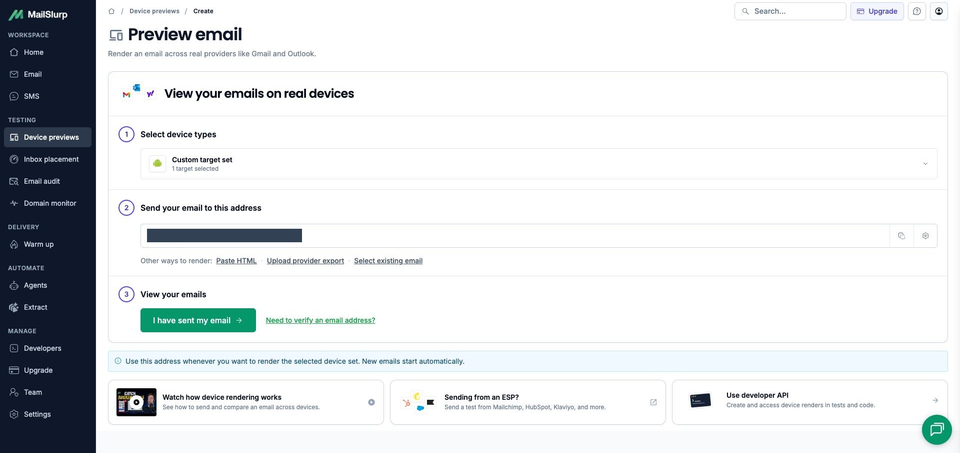
3. Send the campaign and follow its arrival
Send the finished campaign to the render address. If you are working in an email platform, use its supported test-send option and check any personalization or test-message changes before approving the final campaign.
The ClearRoof example uses the subject Before the next downpour: gutter care from $160 + GST. Its fictional offer includes gutter clearing, a downpipe check and photos of the finished work, followed by the starting price, booking action and conditions. A downloadable campaign archive contains the sample design and example links if you want to inspect them.
Back in MailSlurp, choose I have sent my email. This opens the waiting view; receipt starts the render automatically. Our campaign appeared with its matching subject and RUN CREATED. Choose View results to follow the run.
Wait for the run to show COMPLETE and Gmail Android to be READY. In this example, the run finished with one ready result. That means the screenshot is available to inspect; you still need to decide whether the design reads well.
If the result is taking time, check the existing message and run before sending another copy. A send confirmation and a created run are earlier steps than a completed screenshot.
4. Open the screenshot and read the whole email
Open the completed Gmail Android image. The viewer identifies the target as Gmail Android and Native Gmail app on Android. Use the zoom controls to inspect smaller text, or Open to view the image separately.
Start with the photograph and headline, then follow the service descriptions to the price and Book gutter cleaning. Keep going through the conditions and footer.
A tidy thumbnail can hide the very detail you're trying to check. Read the smaller text as carefully as the action: a customer needs to know what the service covers before deciding whether to book.
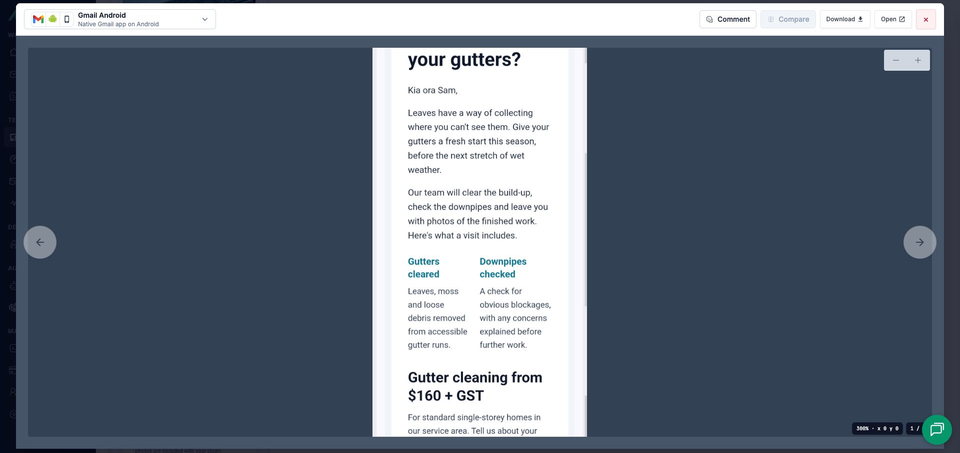

What did the Gmail Android preview show?
The gutter photograph appears below ClearRoof Co. and fills the width of the message's content area. The main heading wraps over two lines: "Time to clear" and "your gutters?" The greeting and introduction follow beneath it, with the service explanation intact.
Gutters cleared and Downpipes checked stay side by side. Both descriptions are present, but their text wraps into short lines. If you replace this copy with longer service names or explanations, this is a useful place to inspect closely before approving the campaign.
The source uses a 600px table with two service cells set to 50% width. It includes a rule requesting stacked cells at 620px or narrower; the captured result still shows two columns. A mobile rule in the source is not enough to tell you how the finished email reads. Google's Gmail CSS reference is useful when checking supported styling, and any layout edit should be followed by another render in the same target.
The starting price remains easy to identify, and Book gutter cleaning keeps its yellow background and dark label. The price conditions, signoff, company details, preferences and unsubscribe links, sample notice and photo credit are visible below. Those quieter parts of the message matter: they explain the offer and give the customer context before booking.
Gmail also shows Always show pictures from this sender above the message, even though the photograph is visible. We did not need to use that prompt to obtain this result. Inspect the actual image rather than treating the prompt alone as evidence that pictures are missing.
Check the real campaign's links separately from a received test message. The sample uses example URLs; a screenshot can show the button's appearance, but it cannot confirm a successful booking.
MailSlurp features for checking and reviewing email
MailSlurp can render the same email across your selected clients, giving you matching screenshots to review. Send the final campaign to a render address, use an exported email to reproduce a reported issue, or import HTML earlier in the design process. The email source guide explains those choices.
Use the full screenshot to identify the text or element that needs attention, then bring a colleague to the result with MailSlurp's comments and share links. A note naming the client and affected service description is easier to act on than "the mobile version looks odd". After an edit, render the revised message in that target again and check the rest of the email too.
For work you repeat, saved target profiles keep the client list consistent between campaigns. The rendering API and CI workflow let engineering teams trigger previews from application tests and keep the screenshots with the test results. That makes the next template change easier to review against the clients you've already chosen.
Which other devices and apps should you test?
Start with another app your customers use. On an iPhone, iOS Mail, Gmail iOS and Outlook iOS are separate targets. Include iPadOS Mail when tablet reading matters, or Apple Mail on macOS for the desktop app. The Apple Mail guide explains those distinctions.
| Device | Email app | Appearance |
|---|---|---|
| Android phones | Gmail, Outlook | Light and dark |
| iPhone | Gmail, Apple Mail, Outlook | Default |
| iPad | Apple Mail | Default |
| Mac | Apple Mail | Default |
| Windows | New Outlook, Outlook Classic | Default |
| Webmail | Gmail | Light and dark |
| Webmail | Outlook.com, Yahoo Mail | Default |
Choose the available clients and modes in your workspace when starting a preview. Test the apps your customers use, including dark mode where it is offered.
If an Outlook user reports a problem, ask whether they use Outlook Classic, New Outlook, Outlook.com or a mobile app. The Outlook guide helps identify the result you need. A Windows screenshot doesn't approve the phone app.
For dark mode, select an available named target such as Gmail Android Dark. Check the current picker before starting each run. Keep the campaign unchanged when comparing clients or modes, so a copy or design edit doesn't become part of the apparent difference.
Why readable offers matter for bookings and sales
Your campaign is asking someone to do something: understand a service, read an offer, finish signing up or return to a basket. If the important details are cramped or the action is hard to spot, you're putting extra work between that person and the next step.
For ClearRoof, the service descriptions and price conditions help someone decide whether to request a visit. They deserve as much care as the photo and headline. Reviewing the whole message helps you catch obstacles before a potential customer has to deal with them.
There is also a separate question of whether the email reaches the inbox. Use inbox placement testing to investigate that. Rendering gives you a chance to improve what the customer reads after opening the email, while you can still change the offer's presentation and next action.