
Email warmup
Documentation navigation
Connect an external sender, ramp message volume gradually, and monitor delivery and provider placement over time.
Email warmup helps a new or recovering sender build a steady sending history. MailSlurp sends paced messages through a connection owned by you, observes controlled-inbox delivery, and can run provider placement checkpoints when your plan includes premium seeds.
Use warmup when introducing a new mailbox, moving a sender to a new provider, repairing a sender after a reputation change, or maintaining low-volume activity between campaigns. Warmup supports deliverability work, but it cannot replace permissioned recipients, correct authentication, or good sending practices.
Start a warmup
- Open Email warmup and select Create warmup.
- Select an existing sending connection or choose a provider to add a new one.
- Verify the credential and complete the test delivery.
- Choose whether you are warming a new sender or repairing an existing sender.
- Select Gentle, Standard, Recovery, or Custom scheduling.
- Choose controlled inboxes or provider placement coverage when available.
- Select managed content or enter a custom subject and plain-text body.
- Create and start the warmup.
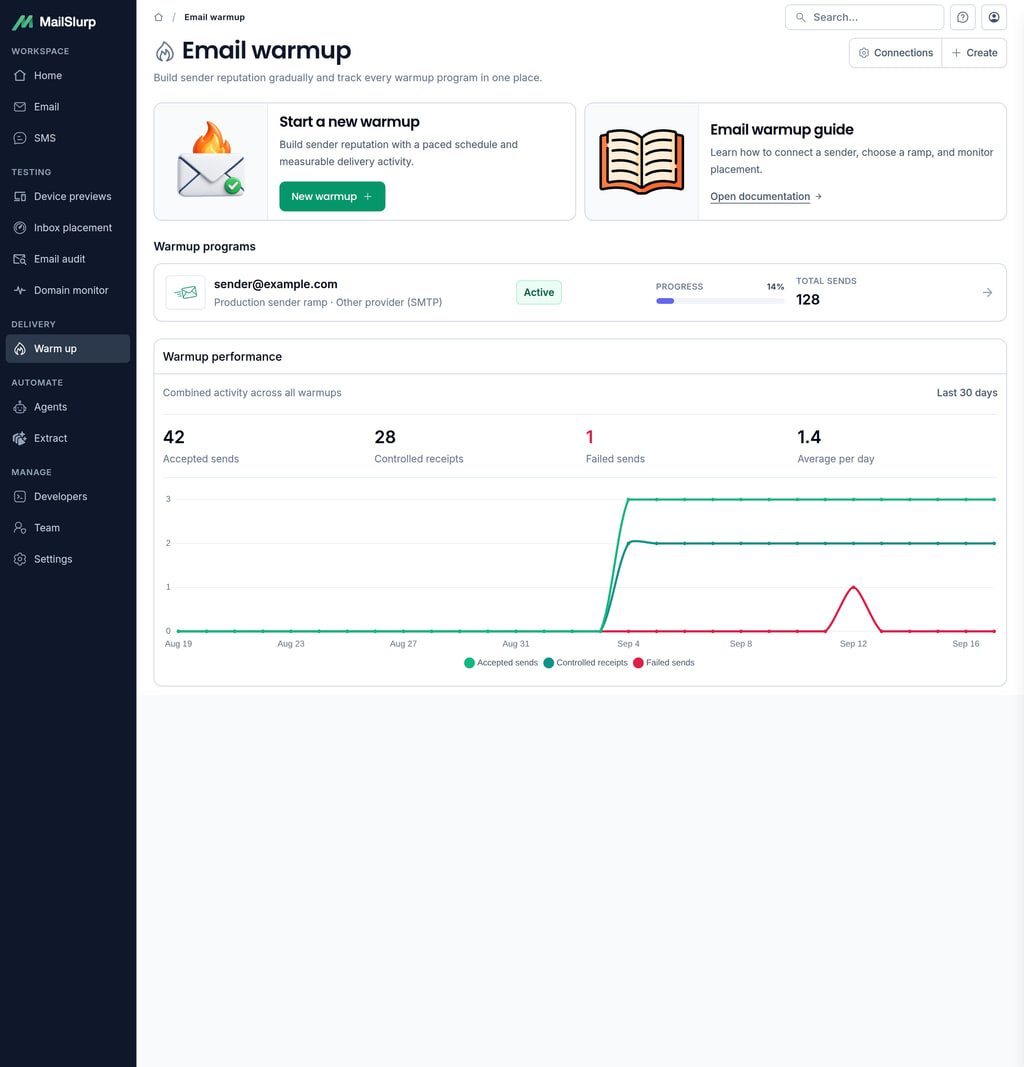
The index lists each sender, status, overall campaign progress, days active, and total sends. The combined activity chart shows accepted warmup sends across all active programs.
Connect a sender
The sender search includes existing reusable connections and the supported provider catalog. Selecting a provider loads its required SMTP or API-key fields. If your provider is not listed, choose Other provider (SMTP) and enter its authenticated SMTP settings.
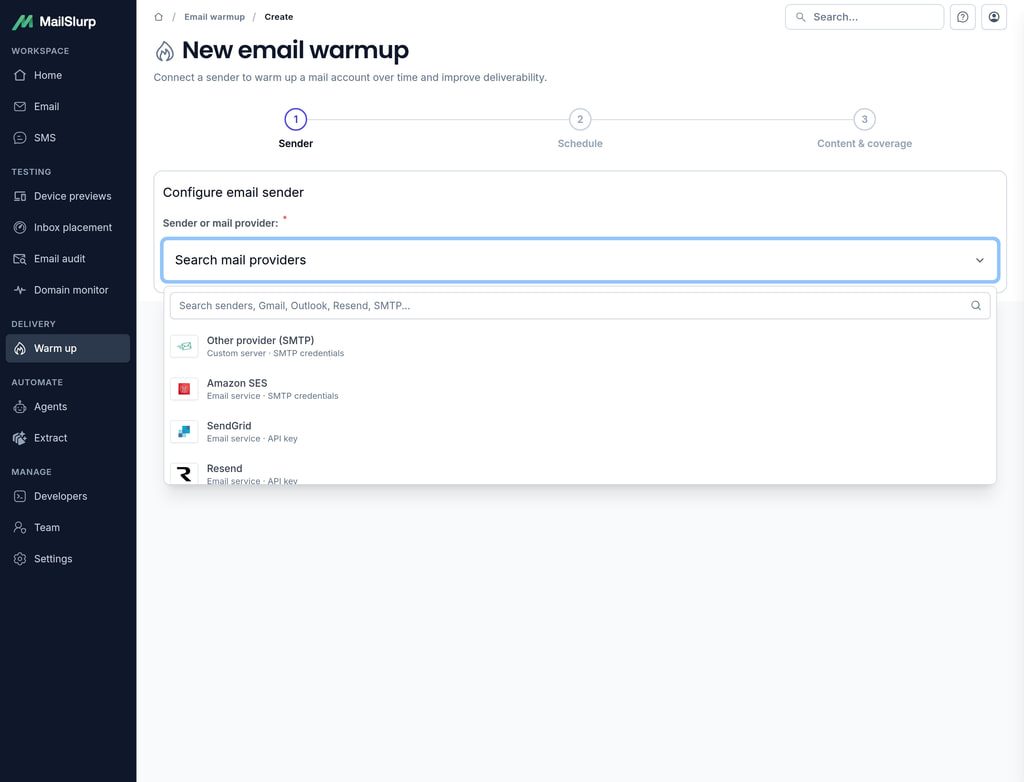
MailSlurp uses the credential only for this customer-owned connection. Native API connections use isolated HTTP clients, and SMTP connections use the server and credential you enter. Amazon SES connections use SES SMTP credentials and do not assume an AWS role.
Choose a goal and schedule
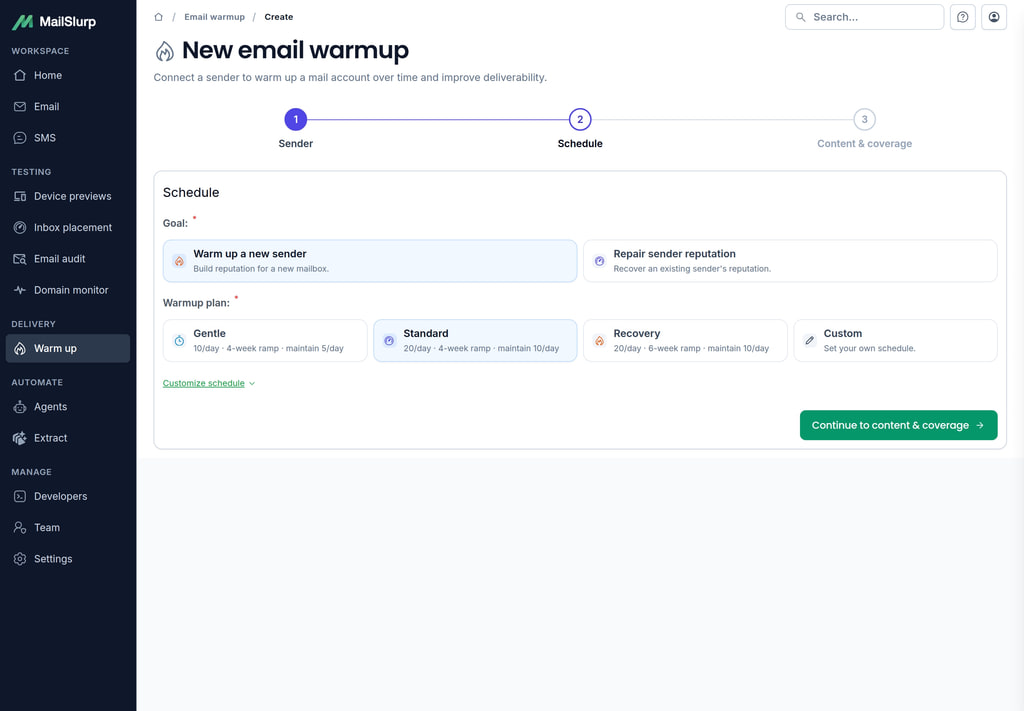
Choose Warm up a new sender for a new mailbox or Repair sender reputation for a sender that needs a slower recovery. The presets store explicit schedule settings:
| Plan | Target volume | Ramp | Maintenance |
|---|---|---|---|
| Gentle | 10 per day | 28 days | 5 per day |
| Standard | 20 per day | 28 days | 10 per day |
| Recovery | 20 per day | 42 days | 10 per day |
| Custom | Your settings | 7-90 days | Your setting |
Open Customize schedule to change the program name, current and target daily volume, ramp duration, maintenance volume, time zone, and local sending window. MailSlurp paces due sends inside that window instead of releasing the daily volume in one burst.
Choose coverage and content
Controlled inboxes provide day-to-day warmup delivery through MailSlurp-managed infrastructure. Premium provider placement checkpoints sample Gmail, Google Workspace, Outlook.com, and Microsoft 365 on eligible plans. Treat checkpoints as directional samples and compare their trend over time.
Managed content varies safe warmup messages for you. Custom content accepts a subject and plain-text body. Keep custom messages natural and transactional; links, tracking, media, scripts, and template markers are rejected.
Monitor and control a warmup
Open a program to see sender identity, status, campaign progress, accepted sends, readiness, adaptive pacing, placement checkpoints, and activity over time. You can pause or resume an active program, edit its schedule, stop it, or delete it after confirmation.
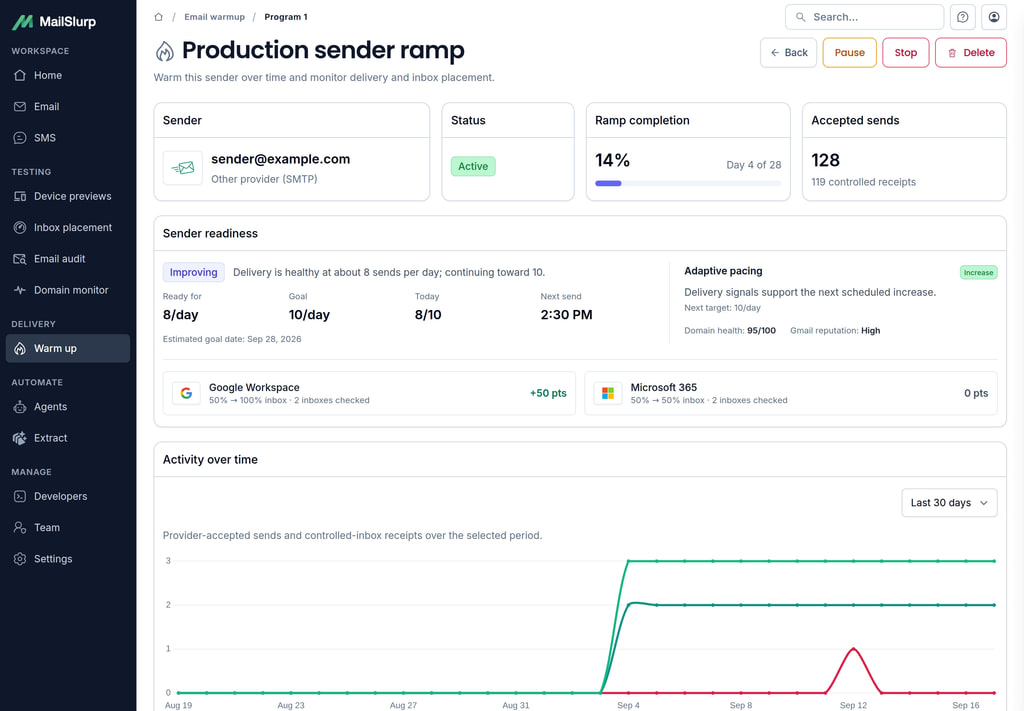
An accepted send counts when the configured provider accepts the outbound request. A later spam, junk, or not-received result remains useful placement evidence and does not undo the send. The warmup page displays included usage and the credit weights applied by your current plan.
Provider setup guides
Choose a provider for exact credential, server, and preparation instructions. Providers marked planned cannot be connected directly yet.
| Provider | Connection | Availability | Setup guide |
|---|---|---|---|
| Other provider (SMTP) | SMTP | Available | Configure Other provider (SMTP) |
| Gmail | SMTP | Available | Configure Gmail |
| Google Workspace | SMTP | Available | Configure Google Workspace |
| Microsoft 365 | SMTP | Available | Configure Microsoft 365 |
| Outlook.com and Hotmail | Not available | Planned | Configure Outlook.com and Hotmail |
| Yahoo Mail | SMTP | Available | Configure Yahoo Mail |
| Apple iCloud Mail | SMTP | Available | Configure Apple iCloud Mail |
| Fastmail | SMTP | Available | Configure Fastmail |
| Zoho Mail | SMTP | Available | Configure Zoho Mail |
| AOL Mail | SMTP | Available | Configure AOL Mail |
| GMX Mail | SMTP | Available | Configure GMX Mail |
| mail.com | SMTP | Available | Configure mail.com |
| Proton Mail | Not available | Planned | Configure Proton Mail |
| Amazon SES | SMTP | Available | Configure Amazon SES |
| SendGrid | API key | Available | Configure SendGrid |
| Resend | API key | Available | Configure Resend |
| Mailgun | API key | Available | Configure Mailgun |
| Postmark | API key | Available | Configure Postmark |
| Brevo | SMTP | Available | Configure Brevo |
| Mailjet | SMTP | Available | Configure Mailjet |
| SparkPost | SMTP | Available | Configure SparkPost |
| SMTP2GO | SMTP | Available | Configure SMTP2GO |
| SendPulse | SMTP | Available | Configure SendPulse |
| SocketLabs | SMTP | Available | Configure SocketLabs |
| MailerSend | SMTP | Available | Configure MailerSend |
| Mailchimp Transactional (Mandrill) | SMTP | Available | Configure Mailchimp Transactional (Mandrill) |
| Elastic Email | SMTP | Available | Configure Elastic Email |
Warmup best practices
- authenticate the sending domain with SPF, DKIM, and DMARC before starting
- use a stable From address and provider configuration during the ramp
- keep the target volume close to the sender’s expected real use
- pause and investigate repeated delivery failures or a worsening placement trend
- keep recipient acquisition and production campaigns permission based
- avoid changing several sender, content, and DNS variables at the same time
- continue monitoring placement after the ramp reaches maintenance volume
Sending connections are shared with automated inbox placement, so one verified sender can be reused across both workflows.